

A featured contribution from Leadership Perspectives: a curated forum reserved for leaders nominated by our subscribers and vetted by the Construction Tech Review Advisory Board.

KPMG Singapore
Building a Winning Strategy

Dr Yap Kwong Weng
A CEO’s main constraints come from client expectations, the company’s cash reserves and directions by the board of directors, among cautious voices urging management to mitigate risk. In the same breath, the desire to create new and different strategies is not necessarily accompanied with the ability to do so.
In the process of doing so, CEOs will have to challenge the norm to create new norms while keeping their cash cows intact.
Back to Singapore, taking innovative approaches is core need, and is no longer a second priority. Already, game changers are continually surprising us, which gives more impetus to better define who we are, why we survive and how we can win in future.
Forming a Propensity to Win
“The only easy day was yesterday,” reads the US Navy SEAL motto on the front gate of the training base in Coronado, San Diego. The SEALs are trained to win from day-one of training in San Diego.
They invest in forming high-performance teams where no man is left behind. But they also emphasize on achieving maximum outputs—completing the mission even though the odds are against them. Accomplishing mission success in the battlefield, keeping up with state-of-the-art weapons, swim times, competitions and so on.
The key point is—they want to win at all costs.
Likewise, for Olympic athletes, they have no qualms about making clear sacrifices because they want to be the best when the time for judgment comes. It is, however, still a matter of personal choice, to want to be the best.
In the business world, there is no such thing as “the best” with the competition-to-be-the-best in most businesses, according to Harvard Professor Michael Porter. To him, there is no such thing as one best hotel, one best car or one best art museum. Services improve and expectations change—that’s the real world in his view.
What matters more is building high performance teams, forming new channels to achieve competitive advantage and creating a culture underscored by a pursuit of excellence— ready to take on new, and sometimes, uncomfortable change initiatives. In the military, one would say: no pain, no gain.
Executing the Alternate Reality
For starters, there needs an establishment of what winning aspirations are, where to play, how to win, what capabilities must be in place and what management systems to push a winning strategy forward, says authors of Playing to Win.
Two questions surround the heart of strategy. What systems should be in place and what capabilities do we need to succeed? These are not the only two factors but it sets a foundation for firms that want to win.
In the process, the ability to build trust and envision an alternate reality is part of a winning process in the process of trust creation, listening and framing. Without trust, there is nothing to look forward to crystallize a winning plan, says strategy expert David Maister in the Trusted Advisor. Some key questions are:
For what are we really aiming here? What will it look like when we get there? How will we know when we are there?
Imagining wins is not about thinking how you get there. It is about discovering moments in the process of thinking during and after you win. It uplifts the mind, ignites creative juices and builds confidence. Very often, it is easy to leave out the envisioning element and to slip straight into planning and execution, after framing the agenda in a change process. It is not surprising that firms who are highly efficient by nature falls into this trap.
In any journey, the starting point is as important as the destination.
When people start to envision their world where problems are not only settled, and it brings forth new ideas that might sound uncomfortable at times, that is a sign that real change could be accomplished. This outcome can only happen if there is real trust between parties, which is difficult especially in large organizations with many levels of hierarchy.
Consider beauty brand Olay. After some years, Olay knew that they were losing out in the saturated beauty market. So they had to change. They focused on innovative solutions in packaging, marketing and distribution. They partnered PR agencies, designers and product innovators to beef up their network alliances and capabilities.
In the change process, they relooked at their consumer patterns, enhanced their brand awareness and developed better go-to-market abilities on a global scale through retailers and formed new supply-chains. They moved from a zone of ‘trying to win’ to ‘winning consistently.’ Olay didn’t stop once they started their journey of change. They capitalized on their wins and made it better with new platforms. The single most important denominator in this concept is consistency.
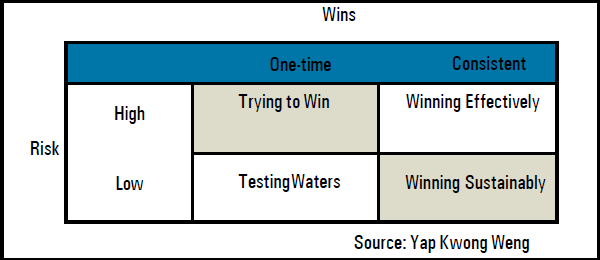
When trying to move from one segment to the other, the risk invariably increases. But the effect is clear. The bar has to be raised and the trust deficit in companies must be filled for anything real to begin with. The need to focus on high performance teams and to envision alternate destination points cannot be left unheard today.
Finally, having a winning strategy is not about disrupting the status quo. It is about recognizing the willingness to change, and creating a solid strategy to win.
Executing the Alternate Reality
For starters, there needs an establishment of what winning aspirations are, where to play, how to win, what capabilities must be in place and what management systems to push a winning strategy forward, says authors of Playing to Win.
Two questions surround the heart of strategy. What systems should be in place and what capabilities do we need to succeed? These are not the only two factors but it sets a foundation for firms that want to win.
In the process, the ability to build trust and envision an alternate reality is part of a winning process in the process of trust creation, listening and framing. Without trust, there is nothing to look forward to crystallize a winning plan, says strategy expert David Maister in the Trusted Advisor. Some key questions are:
For what are we really aiming here? What will it look like when we get there? How will we know when we are there?
Imagining wins is not about thinking how you get there. It is about discovering moments in the process of thinking during and after you win. It uplifts the mind, ignites creative juices and builds confidence. Very often, it is easy to leave out the envisioning element and to slip straight into planning and execution, after framing the agenda in a change process. It is not surprising that firms who are highly efficient by nature falls into this trap.
In any journey, the starting point is as important as the destination.
When people start to envision their world where problems are not only settled, and it brings forth new ideas that might sound uncomfortable at times, that is a sign that real change could be accomplished. This outcome can only happen if there is real trust between parties, which is difficult especially in large organizations with many levels of hierarchy.
Consider beauty brand Olay. After some years, Olay knew that they were losing out in the saturated beauty market. So they had to change. They focused on innovative solutions in packaging, marketing and distribution. They partnered PR agencies, designers and product innovators to beef up their network alliances and capabilities.
In the change process, they relooked at their consumer patterns, enhanced their brand awareness and developed better go-to-market abilities on a global scale through retailers and formed new supply-chains. They moved from a zone of ‘trying to win’ to ‘winning consistently.’ Olay didn’t stop once they started their journey of change. They capitalized on their wins and made it better with new platforms. The single most important denominator in this concept is consistency.
When trying to move from one segment to the other, the risk invariably increases. But the effect is clear. The bar has to be raised and the trust deficit in companies must be filled for anything real to begin with. The need to focus on high performance teams and to envision alternate destination points cannot be left unheard today.
Finally, having a winning strategy is not about disrupting the status quo. It is about recognizing the willingness to change, and creating a solid strategy to win.
The articles from these contributors are based on their personal expertise and viewpoints, and do not necessarily reflect the opinions of their employers or affiliated organizations.
